
By Cameron Kimber, CEE Graduate Student
We’re excited to share the following guest post from one of our collaborators: a Civil and Environmental Engineering graduate student who has been working alongside us at the Red Oak Rain Garden as part of a broader research effort. This project brings together expertise across engineering, applied research, and stormwater management, made possible through support from the Center for Advanced Climate Solutions.
Led by Principal Investigator Camden Arnold of the Prairie Research Institute, the team includes faculty partners Art Schmidt and Ashlynn Stillwell from Civil and Environmental Engineering, graduate researcher Cameron Kimber (our blog author), and the Red Oak Rain Garden team (Eliana Brown, Layne Knoche, and Maddy Craft).
This collaboration reflects the kind of interdisciplinary, place-based work we strive for at RORG, and we’re glad to highlight Cameron’s perspective and contributions.
Introduction: Why monitor a rain garden?
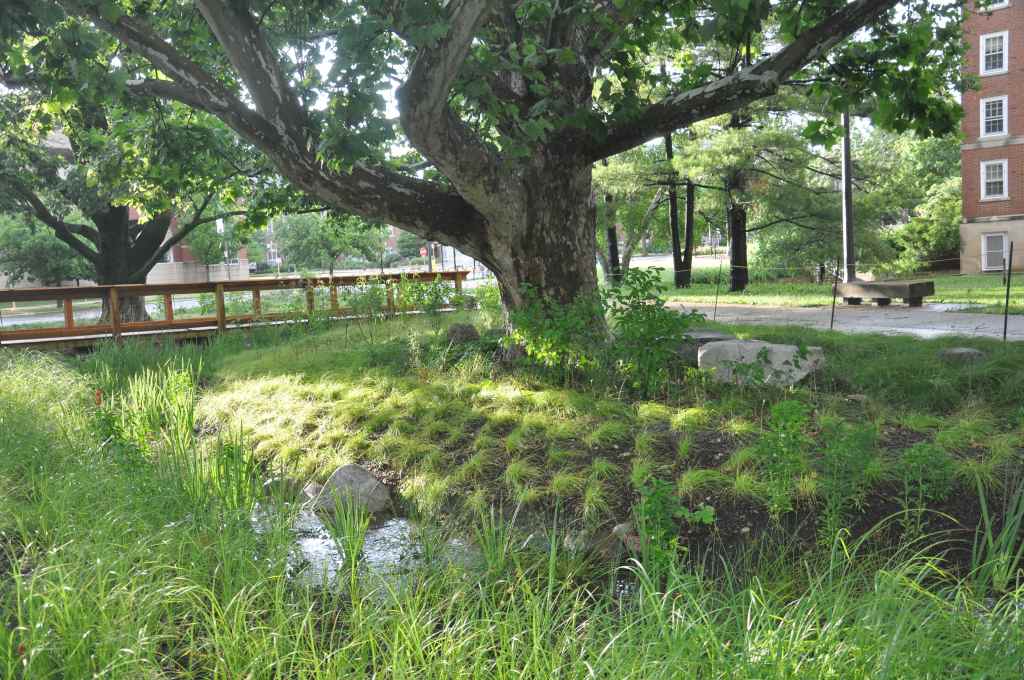
When most people picture rain gardens, they think of patches of native plants that soak up stormwater and add some green to the landscape. That image is true, but for me, a rain garden has also become a living laboratory. Over the past year of my master’s program, I’ve been working on adding instrumentation to the Red Oak Rain Garden to better understand how rain gardens actually perform under real-world conditions.
Stormwater infrastructure is expected to face increasing pressure due to changing weather patterns. Green stormwater infrastructure (GSI), like rain gardens, is widely promoted as a potential remediator of this problem. Yet there is a lack of long-term, high-resolution data to analyze how they function day to day. Collecting continuous data such as soil moisture, precipitation, and evapotranspiration will shed light on how water moves through the rain garden and how performance varies over time.
This blog not only documents the installation process but also highlights the value of measuring nature-based solutions and some of my experiences along the way.
What We Measure & Why
Instrumenting a rain garden is about asking the right questions that are relevant to the site and gathering the data that helps answer them. This project focuses on a few key hydrologic variables:
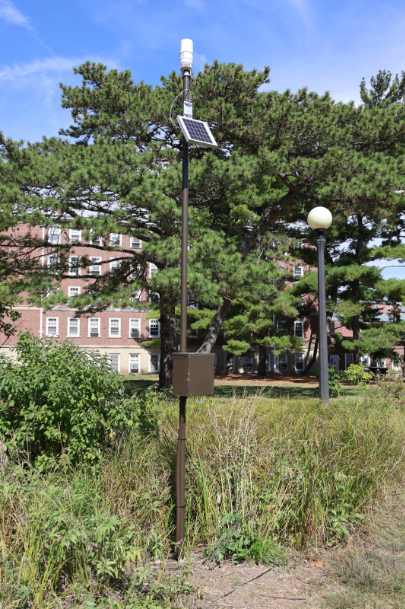
- Rainfall: Measured with an ATMOS41 Gen 2 from METER Group, rainfall is the starting point for any storm event. Knowing how much rain falls during a given storm allows us to compare how much water is entering the system versus how much water is naturally infiltrating into the soil. This helps us understand how the rain garden is performing.
- Weather conditions: Also measured with the ATMOS41 Gen 2, we collect supporting data on air temperature, humidity, wind speed, and solar radiation. These measurements help us estimate how much water leaves the system through evaporation and plant transpiration, which are often combined and referred to as evapotranspiration.
- Soil Moisture & Soil Temperature: Measured with 3 SoilVUE 10 sensors from Campbell Scientific, volumetric water content and temperature are key indicators of how water infiltrates and moves through the soil profile. Each probe records both temperature and volumetric water content, defined as the volume of water relative to the total volume of soil and pore space, at depths of 5, 10, 20, 30, 40, 50, 60, 75, and 100 cm below the surface.
- Outflow: Those familiar with hydrologic modeling might be wondering, ”Great, you’ve estimated inflow, infiltration, and evapotranspiration, but to complete the water balance, you’ll also need to measure flow out of the system”. In most cases, this would be true. However, for this site, we do not measure overflow because the Red Oak Rain Garden is designed so that overflow is exceedingly rare. Therefore, it’s a safe assumption that during the vast majority of storm events, outflow is effectively zero. In other words, all of the water that enters the rain garden either naturally infiltrates into the soil or leaves through evapotranspiration.
The placement of each instrument was designed to provide us with a holistic view of how water infiltrates across the rain garden, where ponding is most likely to happen.
Monitoring Equipment Setup
The approximate locations of the probes, along with the monitoring pole and attached weather station, are shown below:
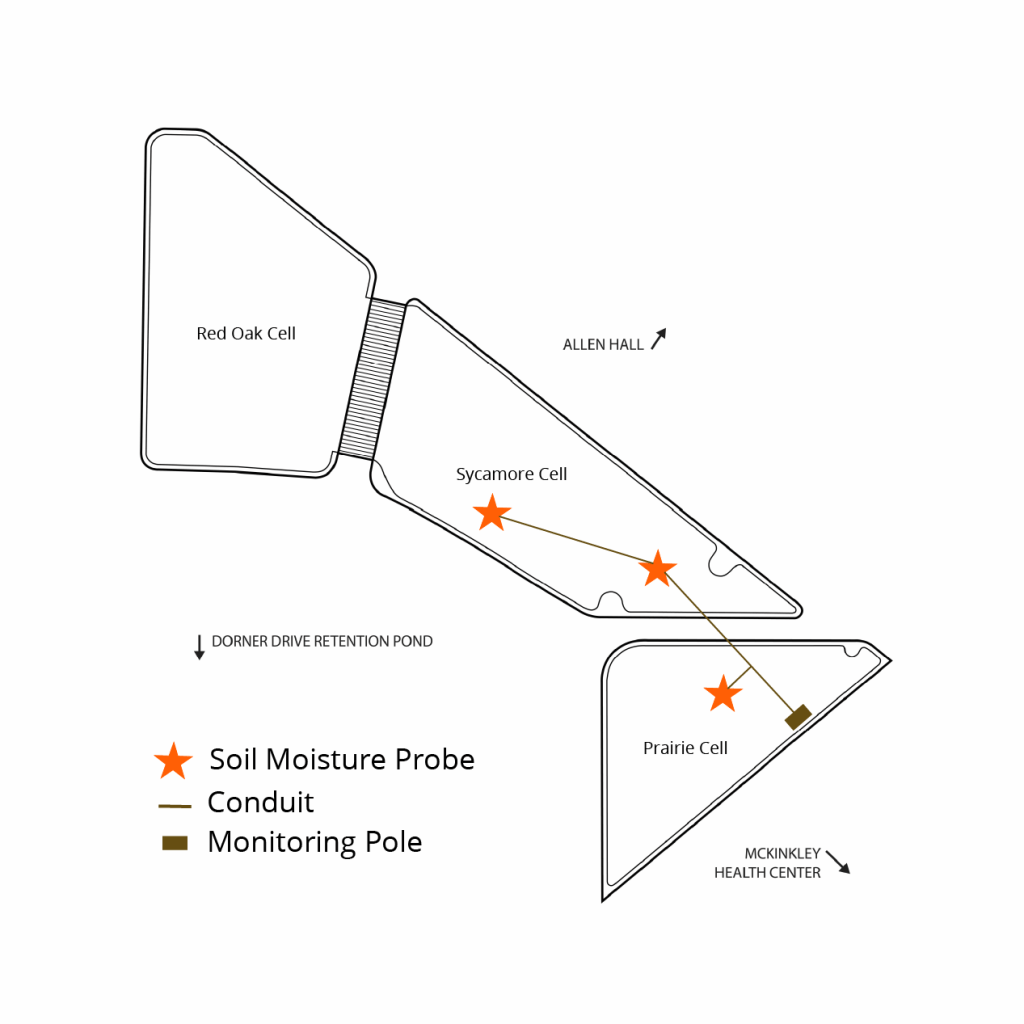
These probes are strategically placed to provide insight into how water moves through the subsurface and how drainage characteristics differ between RORG’s prairie cell and sycamore cell. The prairie cell contains an engineered soil mix, while the sycamore cell consists of non-engineered, unamended soil. Engineered soil mixes incorporate sand to increase infiltration rates, allowing water to move quicker through the subsurface. One of the results we expect to see from the data we collect is how much of a difference soil composition (i.e., engineered vs non-engineered mix) makes in the overall infiltration capabilities of the rain garden.
Each of these measurements will help us answer the larger question: How well is this rain garden managing stormwater under real and varying hydrologic conditions? Collectively, the data we collect can be used to create a picture of the garden’s overall performance as it changes over the course of major storm events and throughout seasons.
Early Data & Insights
Although the installation is still new and systems are being fine-tuned, early data are already revealing several interesting patterns from the measurements collected so far:
At shallow depths, the soil in all three cells responds almost immediately to the rainfall, spiking quickly and then drying out within a couple of days. In the first sensor, located in the prairie cell, this response is observed throughout nearly the entire soil profile. In contrast, sensors 2 and 3, located in the sycamore cell, show a more muted and delayed response suggesting slower infiltration deeper in the profile. Possible explanations include the absence of an engineered soil mix in this part of the garden or the influence of the mature sycamore tree on soil structure and water uptake. Field observations support this theory. During installation, Maddy Craft and I encountered a dense clay layer below the surface in both cells with the non-engineered mix. Together, these findings move the analysis beyond a simple success or failure framework by illustrating the actual processes through which RORG manages water across soil layers.
While the data we’ve collected so far is limited, it already helps reinforce some of the core reasons rain gardens are built in the first place: to slow runoff, promote infiltration, and provide a buffer against rainfall events that could otherwise contribute to flooding. As the instruments continue recording across seasons, I’m excited to see how performance changes under different rainfall conditions, vegetation growth stages, temperature, and soil moisture conditions.
It’s worth noting that, for now, data must be downloaded directly from the equipment on-site. University Wi-Fi at the rain garden is unreliable, so until connectivity in this area is improved, the data cannot be automatically uploaded to a server. Enabling digital uploads would streamline data collection and eliminate the need for personnel to manually retrieve the data. The RORG Team is pursuing avenues to support this initiative.
Big Picture & Closing Thoughts
While it can be easy to get caught up in the day-to-day challenges of installation, it is important to step back and acknowledge why this work matters. Stormwater is becoming a central challenge for communities everywhere. As extreme rainfall events become more frequent, existing stormwater infrastructure continues to age, and rapid land development occurs, GSI systems like the Red Oak Rain Garden offer a more sustainable path forward.
By instrumenting this site, we’re helping build the evidence base that policymakers, practitioners, and community members need to guide investment and policy around GSI. In the long term, this data can also inform design standards and highlight critical knowledge gaps. This project has also served as a reminder that applied research depends as much on persistence and collaboration as it does on technical skill. From troubleshooting instrumentation issues to coordinating with the rest of the team on planning and fieldwork, it’s become clear that the installation, maintenance, and monitoring of nature-based solutions is a multi-disciplinary, community effort.
Lessons from the Field
There are many lessons I’ve learned through this project, one of which is the importance of careful probe installation. Small mistakes during installation, such as digging the holes for the probes too wide or not packing the soil tightly enough around the sensor, can lead to data that appears fine on paper but may not reflect what’s actually happening within the soil.
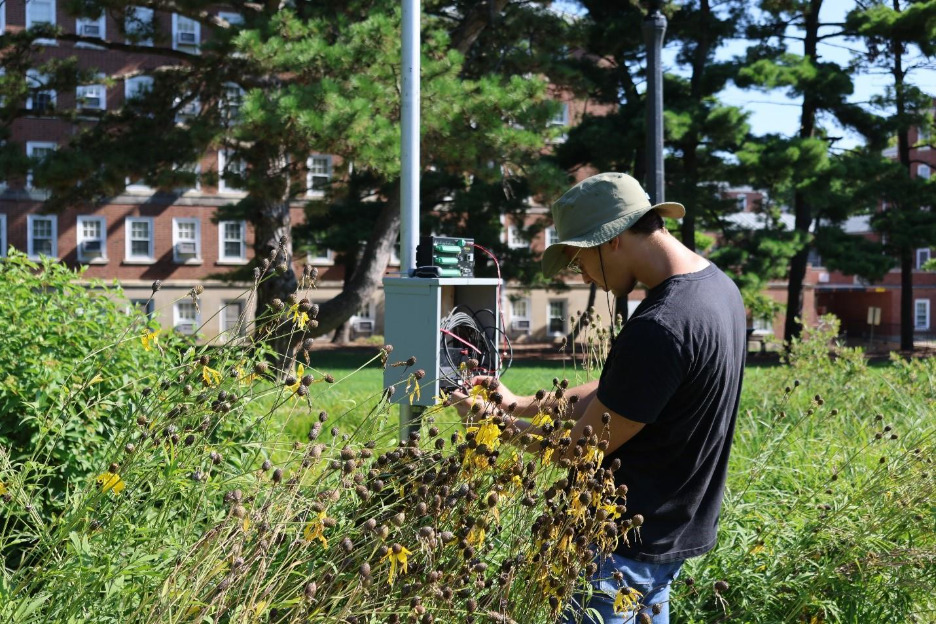
Another key takeaway I’ve learned is that cable management and protection are not as simple as they may seem. A rain garden is, by definition, a wet environment, and the Red Oak Rain Garden often has workdays where volunteers may be out in the garden digging with shovels. Therefore, making sure the cables are organized and protected from external damage has been a challenging part of this project. We had to think of how and where to route cables, secure junction boxes, and seal connections to protect the wires and ensure everything functions safely.
Perhaps the most important and most human lesson is patience and adaptability. Fieldwork inevitably comes with setbacks due to weather, unexpected soil conditions, equipment limittions and even the occasional curious wildlife we needed to work around. For example, Maddy and I once planned to spend an afternoon installing soil moisture probes, only to have an unexpected heavy rain force us to reschedule. On another occasion, while installing the weather station, we discovered our ladder was just short of safely reaching the top of the pole, requiring us to regroup, find a taller ladder, and return on another day.
Challenges like these occurred frequently throughout the installation. Learning to adjust, troubleshoot, and even laugh off setbacks has been just as important as any technical skill I have gained along the way.

Cameron Kimber
Civil and Environmental Engineering
Cameron Kimber is an M.S. student in the Water Resources Engineering and Science area in Civil and Environmental Engineering at the University of Illinois Urbana-Champaign. His research focuses on quantifying hydrologic performance of green stormwater infrastructure and creating decision support tools for implementing nature-based solutions in rural Illinois communities.
Cam received his B.S. in Civil Engineering from the University of Illinois Urbana-Champaign in 2024. As an undergraduate, Cam was active in undergraduate research where he used data analysis and pattern recognition to understand residential water end uses.

