
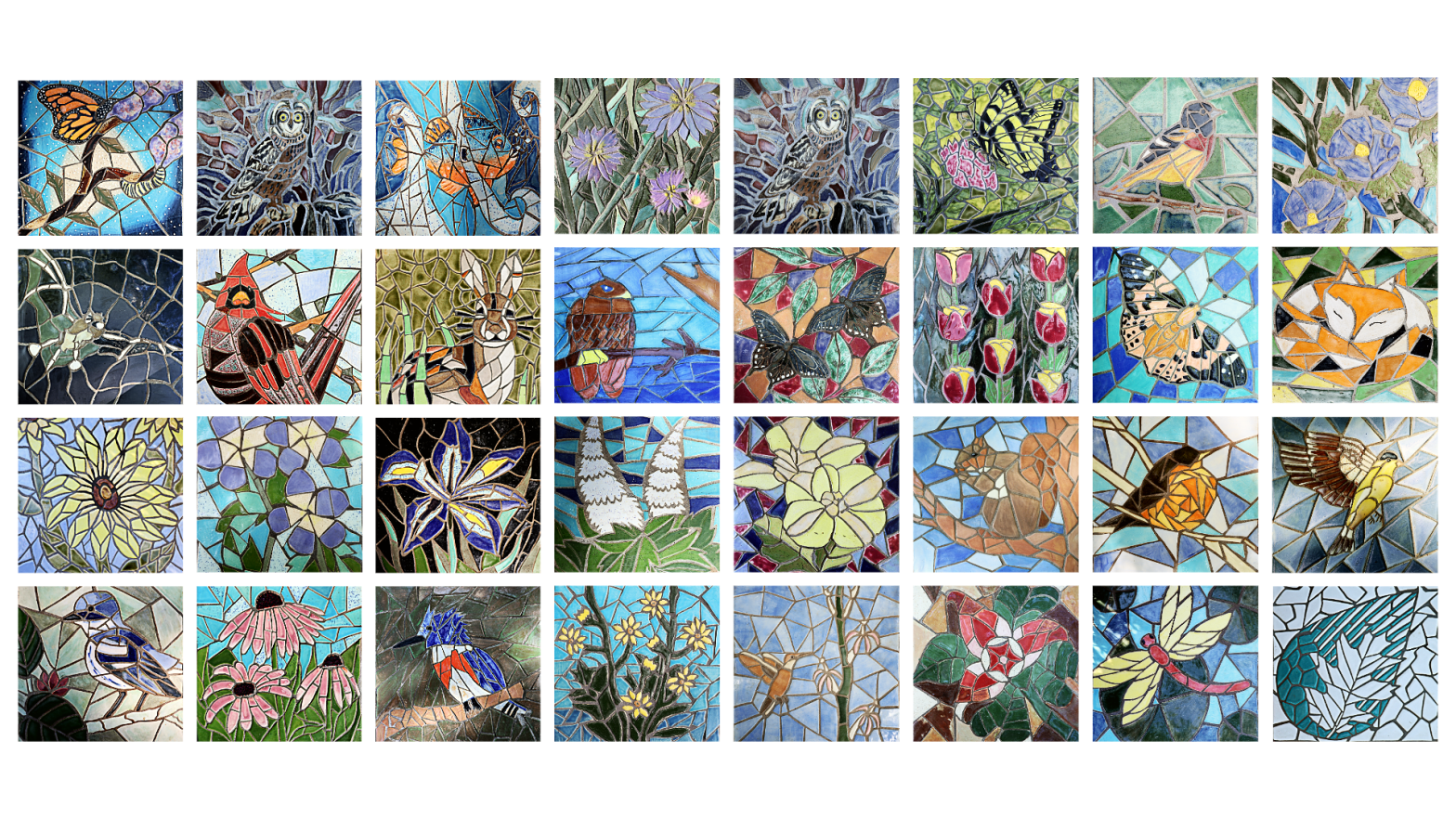
For six years now, the student-made mosaics at the Red Oak Rain Garden have added bursts of color and personality to the paths. They’re carefully placed, nestled into the edges of the garden where plants meet pavement, and feel like they’ve always belonged here.
In the fall, I visited the Allen Hall/Unit One ceramics studio to talk with Catherine Wiesener, the instructor who has guided students through the mosaic project since the very beginning. What started as a class assignment has grown into a long-running collaboration between her students and the rain garden, one that blends art, nature, and sustainability in a beautiful way.
Looking Back at the First Tiles
When I asked Catherine what comes to mind after all these years, she immediately thought of the students. “First, I remember the students who made the tiles.” Mosaics were installed in 2019, then again in 2021 and 2024. Each set represents a different group of students, and each tile tells a little story on its own. Catherine said she feels inspired every time she sees them in the garden. “I feel proud of our contribution to campus and to a very special place that people come to.” Visitors love noticing the mosaics as they wander through, and that shared joy has become part of the legacy, too.
Surviving Snow, Rain, and Everything in Between
One thing that has surprised Catherine: none of the mosaics have ever failed, not a single one. They’ve been through snowstorms, heavy rains, drought, and plenty of freeze–thaw cycles. One was even mysteriously removed, only to turn back up a week later! But they still look as bright and fresh as the day they were installed. She mentioned that “The glaze has held up really well. The grout, too. I’m shocked.” I’ve seen this firsthand while working in the rain garden. Every time I stop by, I’m struck by how delicate and beautiful, yet sturdy, the mosaics still are.
How the Garden Inspired Her Own Home
The rain garden hasn’t just inspired students; it even inspired Catherine’s yard. She planted her own native rain garden at home using RORG’s plant list as a guide. Even after six weeks without rain this summer, everything is thriving. Catherine mentioned that “Native plants are built for this type of drought environment.” She’s slowly turning more and more of her yard into native plantings, exemplifying how demonstration sites like the Red Oak Rain Garden encourage others to choose resilient landscapes at home.
Sustainability in the Studio
Catherine’s studio is built around reuse and intention. All clay scraps are recycled; some pieces might even include clay from ten years ago. Catherine mentioned that “it’s a delicate balance between being an artist who uses energy and natural resources and doing it responsibly.” Students learn to create thoughtfully and understand where their materials come from.
This element of sustainability that Catherine teaches was also incorporated into a large new ceramic piece displayed along the back wall of her studio. This piece represents a community, with the blue tiles forming a river, the multicolored tiles representing villages, and the green and brown tiles serving as farms and natural spaces. The piece was intentionally created with recycled clay materials and natural tones, giving it the feeling of looking out onto a landscape. And if you look closely, there’s even a tile modeled for the Red Oak Rain Garden!
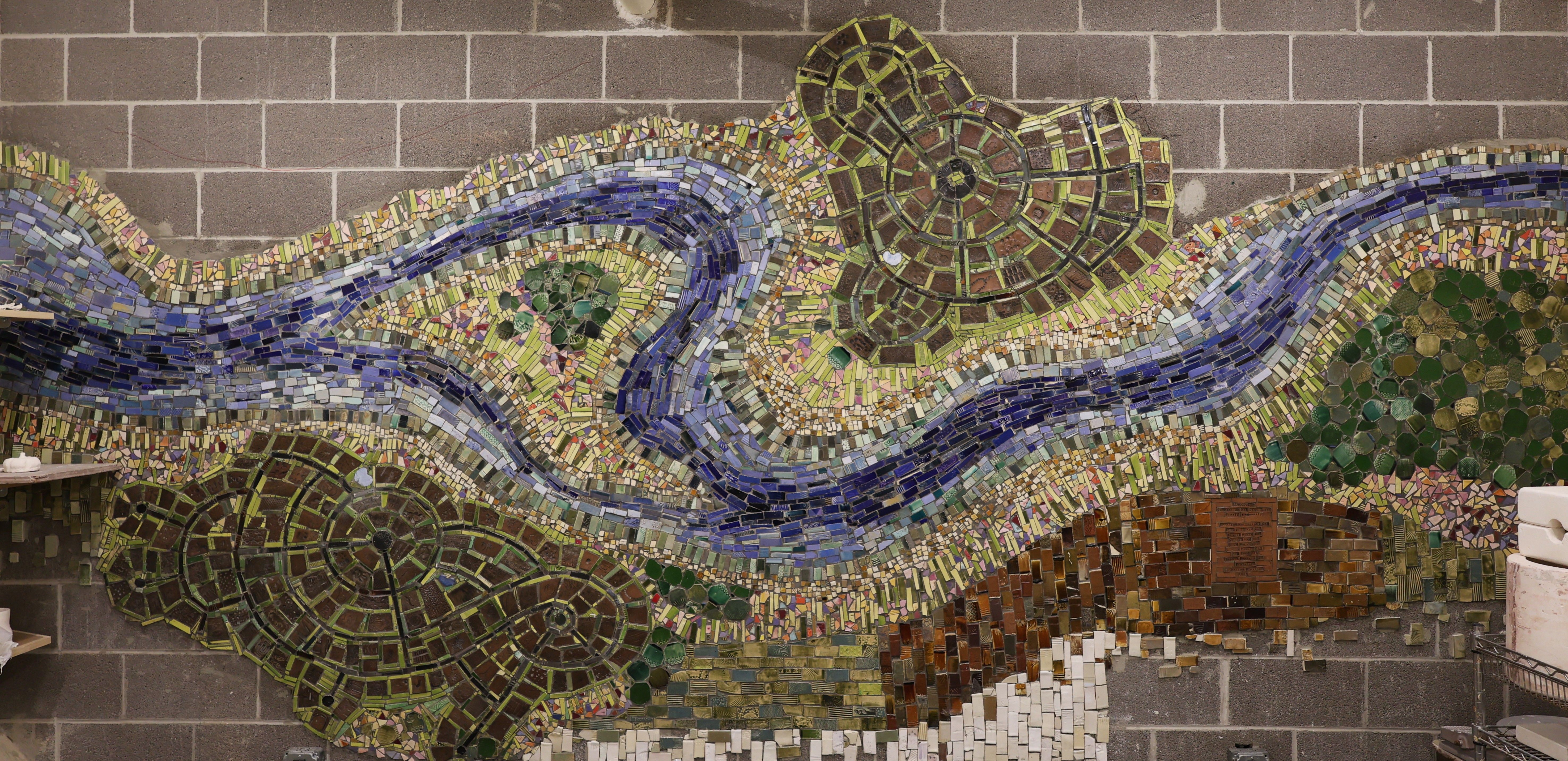
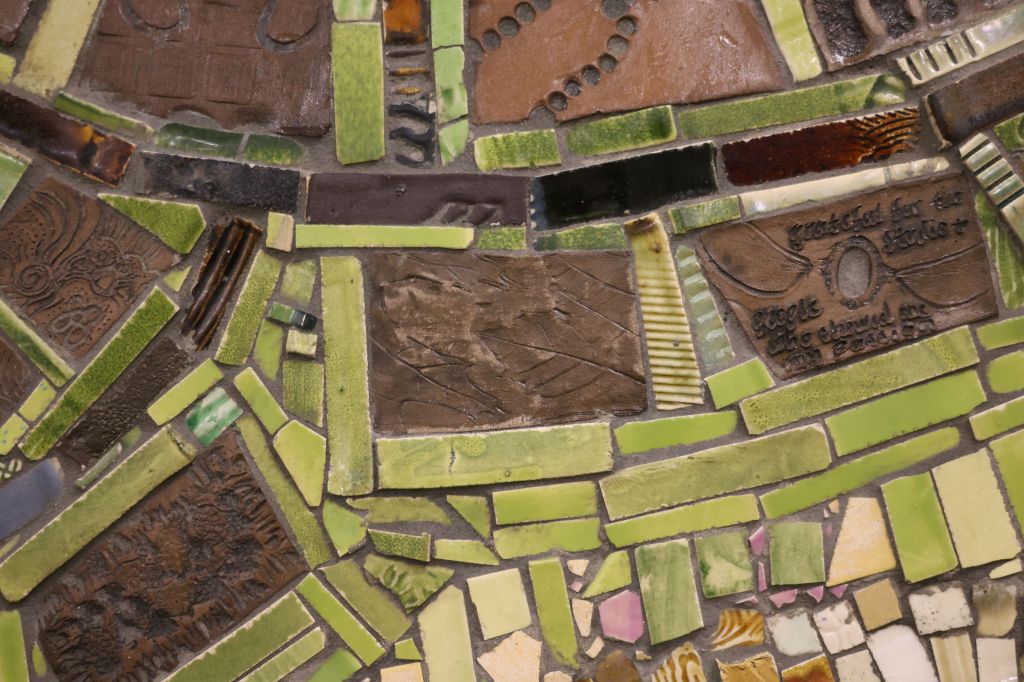
The artwork has a calm presence, sitting as a gentle anchor among shelves of student work. It’s also the kind of artwork that grows slowly over time, the same way her students’ mosaics grow into the Rain Garden.
Advice for Artists Who Want to Support the Environment
Her advice was simple: “Find someone in an environmental field you’re interested in and collaborate.” Catherine spoke warmly about working with Eliana Brown, who has helped her students understand the environmental story behind the garden.
A Peek at the 2026 Mosaics
Yes, new mosaics are coming this spring!
The process is the same each year:
- The RORG team shares a list of plants and animals the garden supports.
- Students choose one that inspires them.
- They design a mosaic within a square tile. (Catherine said the square is surprisingly hard to design!)
Every year, she’s impressed by what students create.
Beyond RORG: Birdhouses and Architecture
Catherine is also part of a project designing 3D-printed ceramic birdhouses for urban areas where migratory birds lose habitat due to construction. She’s responsible for the glazing and ceramic finishing. It’s another example of how art, design, and engineering can fit together in unexpected ways.
A Living Legacy
Leaving the ceramics studio, I felt moved by the work Catherine and her students have done over the years. The mosaics aren’t just decorations; they’re memories, stories, and examples of what happens when people care about both art and the environment. They remind us that creativity can take root anywhere, even along the edge of a rain garden path. And as the garden continues to grow, so does the community behind it.

Jenna Balaban
Environmental Engineering
Jenna is a junior studying Environmental Engineering at the University of Illinois. She is passionate about protecting water resources and advancing sustainable infrastructure that heals ecosystems. She is especially interested in how nature can serve as a powerful defense against flooding, erosion, and climate change. In her free time, Jenna enjoys painting and going on nature walks.
Under the guidance of the RORG Team, Jenna is involved with Extension stormwater projects and green infrastructure community outreach.
 Red Oak Rain Garden
One thought on “Art in the Garden: A Conversation with Catherine Wiesener on the Red Oak Rain Garden Mosaics ”
Comments are closed.