
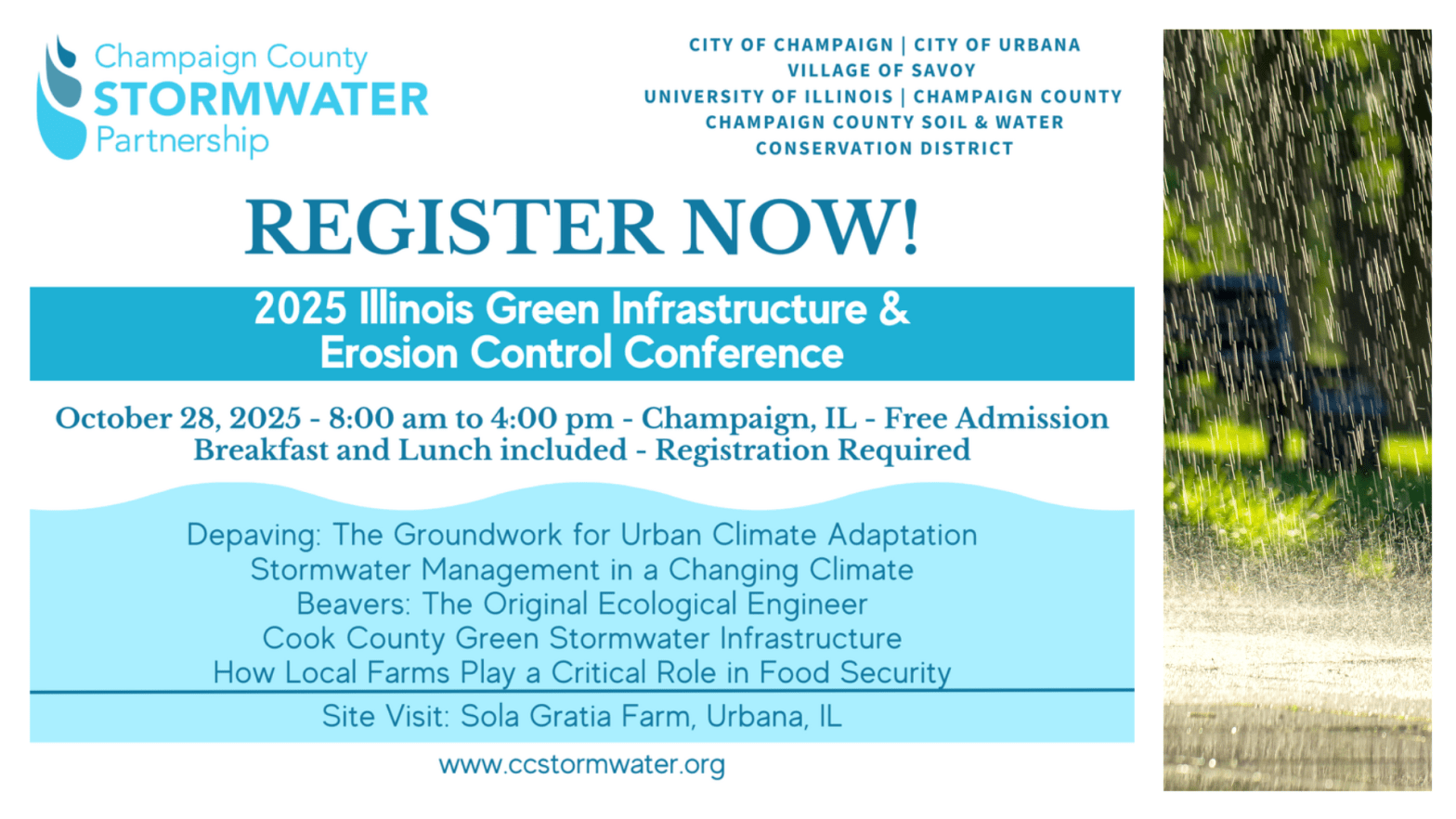
I recently had the chance to sit down with Betsy Jo Richardson and Colleen Ruhter, two of the organizers behind the Green Infrastructure & Erosion Control Conference. While the conference has always been a space to learn, in 2025 it’s opening its arms even wider. This year, the focus stretches to include broader topics and how they all tie back to the way we think about water.
The conference takes place on Tuesday, October 28 at the iHotel and Conference Center in Champaign. Admission is free, but be sure to register by Tuesday, October 14! Note: registration for the afternoon tour at Sola Gratia Farm is at capacity.
A Wider Lens on Stormwater
Richardson noted, “We’ve always covered green infrastructure and erosion control. What’s different now is the breadth.” This includes additional topics such as wildlife (hello, beavers!). Ruhter added with a reflection of her own, “It’s not just calculations and concrete. It’s design, stewardship, and community.”
A Conference for Everyone
When I asked how the event serves the community, Richardson explained that the audience has grown. It used to be mainly contractors, but now the topics of discussion speak to engineers, professors, students, residents, and even neighborhood groups. For example, a homeowner might leave knowing how to install native plants or depave a strip of driveway. An engineer might pick up ideas for more nature-based design. A student might simply feel a spark of possibility: Oh, I didn’t know people could do this for a living.
From Water to Food: Why It All Connects
One part that really inspired me was the connection to food. According to the United Health Foundation, 12.4% of Illinois households experience food insecurity. “Stormwater and soil health affect whether communities can grow food at all,” Ruhter explained. “Clean water and clean soil are preconditions for food equity.” The conference offered a chance to see that connection firsthand through a visit to Sola Gratia Farm, a nonprofit urban farm that donates much of its harvest to local hunger programs. Hearing this helped me see stormwater in a new way. It’s not just about managing runoff and flooding, but also about what ultimately ends up on the table.
From Inspiration to Action
Both Richardson and Ruhter shared that the goal of the conference is to send people home with simple but valuable actions like planting a pollinator-friendly perennial, adding a rain barrel, and picking up litter. When multiplied across neighborhoods, towns and cities, these steps create ripple effects that can help heal and strengthen our ecosystems and communities.
A tradition that keeps growing
Looking back, Richardson mentioned that the very first conference happened in 2004. Since then, it’s been held every two years, growing from a contractor-focused erosion control workshop into something much bigger. “We aim for all-inclusive thinking now,” she said. “Not only planning and design, but environmental stewardship, the everyday choices that make systems work.”
Behind the Scenes: Their Favorite Part
When I asked what they enjoyed most about putting the event together, Ruhter laughed: “The stickers! We’ve got Champaign County Stormwater Partnership stickers this year. I love designing and shopping for little touches like that.” Richarson’s favorite moment hasn’t arrived yet. “It’s the day of the event,” she said. “You see the presenters, the audience, the conversations, lightbulbs going off in people’s heads. That’s always the best part.”
Final Thoughts
Our conversation helped me see how deeply stormwater influences everything, from soil and food to residents, engineers, and even beavers. As an Environmental Engineering student, I’m eager to learn from the conference speakers and apply those insights to my studies and future work.

Jenna Balaban is a junior studying Environmental Engineering at the University of Illinois. She is passionate about protecting water resources and advancing sustainable infrastructure that heals ecosystems. She is especially interested in how nature can serve as a powerful defense against flooding and erosion. In her free time, Jenna enjoys painting and going on nature walks.
Under the guidance of the RORG Team, Jenna is involved with Extension stormwater projects and green infrastructure community outreach.
 Red Oak Rain Garden