

As a senior in Sustainable Design at Illinois, I spent my last semester as an undergrad focused on my Capstone project, which acted as a culmination of everything I have learned in my college education. I independently chose my problem topic, researched it, and designed a solution. With all of my passion and experience with the Red Oak Rain Garden, I wanted my project to emulate it to some degree. After many dedicated hours of researching and designing, I ended up with the New Lincoln Quad: an environmentally-friendly, relaxing green space dedicated to the student population of the Indiana State University (ISU) campus in Terre Haute, IN.
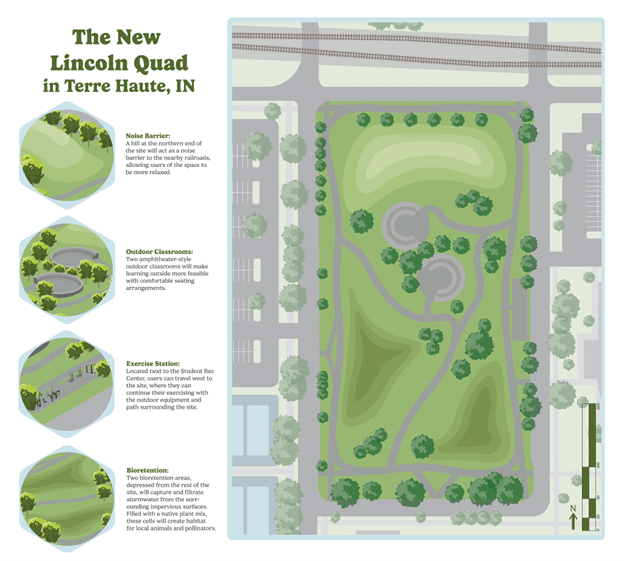
The Process
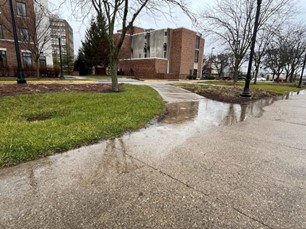
I deliberated for a long time on a suitable location for my project. I knew of a number of urban sites that had flooding issues, like my hometown neighborhood in Rockford, Illinois, or on our University of Illinois campus. However, I found that plans were already in place for the sites I had in mind! Given this, I widened my list of possible locations. As I discussed this issue with my partner and our friends, they made me aware of the stormwater issues on their college campus at Indiana State University (ISU). So, the next time I was in Terre Haute visiting them, we went on a tour of their campus, specifically the areas that they knew had flooding problems. That is where I found my site: a large empty plot of lawn, which I found out to be the site of a former dormitory (now demolished), called the Lincoln Quadrangle.
This underutilized space was perfect for some kind of intervention, and that is exactly what I planned to do for my project. However, I wanted to hear more about the space and its future than just from the people I know, so I set out to survey some of the ISU student population. My biggest takeaway from talking to students was that they had very little outdoor space that excited them or made them feel safe, causing them to be more sedentary and stuck inside – especially students who did not have a car to drive to nearby parks. I knew the site had flooding issues as well, like other areas of Terre Haute. I also knew that ISU could financially benefit from a space like this to pride itself on to possible students, staff, and possible donors.

The key strategy to building sustainably is acknowledging the Three E’s: Environment, Equity, and Economy. Ignoring even one of the E’s will make your project less feasible and sustainable. I made sure to think of all three in the process of this design:
- For Environment, I planned to have ample space filled with native plants, in part for bioretention purposes, in part for habitat creation, and in part for a beautified and purposeful space.
- For Equity, I planned this space for the students, but the campus is open to all and can easily share its amenities with the surrounding neighborhoods.
- For the Economy, the site is intended to be a point of pride for ISU, attracting more students and, therefore, generating additional revenue for the university.
Primarily, I used Adobe Illustrator for the graphics of my poster. The information from RORG’s garden guides, ISU student articles about the site, and numerous other sources proved to be very helpful. Throughout the semester, I received valuable critiques and learned a great deal from fellow sustainable designers and professors in my capstone class. I am grateful for that group of people, as my project would not be nearly as good without their input and support!
The Presentation
My classmates and I presented our posters to peers, teachers, and other interested parties at the Sustainable Design Capstone Exhibition in the Art + Design Building on campus. I loved hearing about all the incredible projects, and I was proud of what we accomplished together. Although I had a few assignments left for other courses, that night felt like the true end of my time as a student at the University of Illinois. I’m grateful to continue this kind of work with the Red Oak Rain Garden and Illinois Extension, and I am excited to see sustainable design and native plants flourish in their natural habitats!

My project text follows:
The New Lincoln Quad: From demolished dormitory to green oasis on the Indiana State University Campus in Terre Haute, IN.
Currently, the site consists of a few trees, and an extensive expanse of lawn. The surrounding sidewalks and the lawn floods, making the whole area inaccessible during and after rain events. After conducting interviews with students on the ISU campus, I learned that there are few designated outdoor spaces on campus that students feel safe and happy at. This new and improved site plan focuses on three main aspects.
1) The site targets ISU student and faculty connections with nature through providing places to relax, learn, and exercise outdoors in a safe and environmentally-friendly way.
2) The site aims to implement green stormwater infrastructure, with two large bioretention cells that will capture, filter, infiltrate, and transpire stormwater which will, in turn, improve the downstream water quality of the Wabash River and mitigate flooding issues.
3) The site will be planted with Indiana native plants to create and support habitat and food sources for local animals and pollinators.

Madelyn Craft is a recent graduate of the University of Illinois, majoring in Sustainable Design with minors in Landscape Studies and Natural Resource Conservation. She is most interested in native plants, environmental restoration, and green infrastructure. She is pursuing a career in urban landscape restoration with the hopes that she can design landscapes that are both aesthetically pleasing and environmentally beneficial to help create healthier communities.
 Red Oak Rain Garden